
The World Meteorological Organization (WMO) issued its latest update in Geneva on 3 September 2026, stating that El Niño has become firmly established and will strengthen to very strong intensity in the coming months. The event is expected to significantly affect global rainfall and temperature patterns, bringing associated risks of floods, droughts and extreme heat.
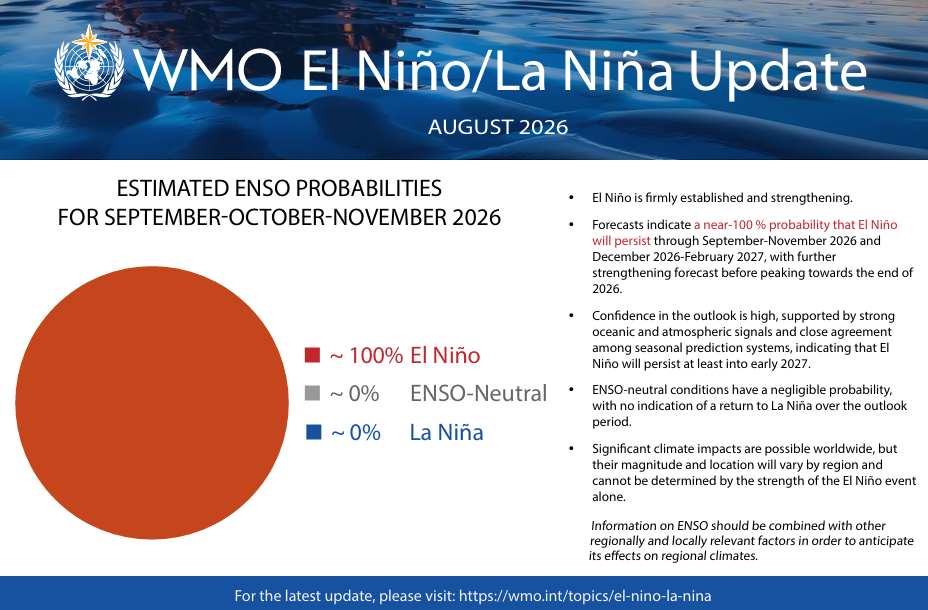
Forecasts from WMO Global Producing Centres show an exceptionally high probability, close to 100%, that El Niño will last until February 2027. This is the first time WMO has made such a definitive assessment in its El Niño/La Niña update, reflecting strong agreement across the global observing and modelling network. With sea-surface temperatures in the equatorial Pacific well above average, El Niño is expected to continue intensifying and reach its peak around the end of the year, while its climate impacts extend into 2027.
The UN Secretary-General said El Niño is being ‘amplified’ before our very eyes; with sea-surface and global temperatures continuing to rise, the world is in the danger zone of extreme weather and must protect people through concrete climate action. The WMO Secretary-General said this exceptional El Niño demands exceptional preparedness and response, and WMO is working with national meteorological and hydrological services to turn forecasts and climate information into disaster prevention and risk reduction action.

From a meteorological monitoring technology and applications perspective, this very strong El Niño is a reminder that high-density, real-time, stable observation capability is the first step in addressing the extreme weather chain. Anomalies in sea surface temperature, wind fields, rainfall and lightning often emerge before hazardous weather fully materialises. An integrated observation network covering micro weather stations, ultrasonic anemometers, atmospheric electric field monitors and water quality sensors can help users identify risks more quickly at local scales.
For the commercial weather services industry, warnings also need to be converted into actionable responses. Over the coming months, monitoring-data fusion, sectoral risk models and scenario-based warning services linked to El Niño impacts will be especially critical. Transportation, energy, water utilities and agriculture should prepare in advance, using real-time observations and short-term nowcasting to reduce disruptions to production and daily life caused by floods, droughts, heatwaves and other extreme events.
Source: World Meteorological Organization (WMO) (https://wmo.int/media/news/el-nino-set-become-very-strong-raising-risks-of-extreme-weather-2027)