
According to the World Meteorological Organization, the Addis Ababa Action Call for Early Warnings for Africa states that no individual, community, or country should be left defenseless in the face of predictable hazards. Advancing the Early Warnings for All initiative to achieve universal, effective, and sustainable multi-hazard early warning coverage by 2027 remains the core direction.

Since the United Nations Secretary-General launched the Early Warnings for All initiative in 2022, early warning system development in Africa has made positive progress. Currently, 41 African countries have reported progress in building their early warning systems, with system completeness more than doubling since 2022. Cross-border cooperation and regional early warning mechanisms have been advanced through the Africa Multi-Hazard Early Warning and Early Action System (AMHEWAS). Yet progress is uneven: Small Island Developing States, Least Developed Countries, and vulnerable countries still show significant gaps, and many communities remain without effective protection.
At the same time, the challenges facing early warning development in Africa remain acute: infrastructure and observation networks need greater investment, forecasting and early warning capacities need to be strengthened, and warning information does not always reach the “last mile.” In some countries, early warning responsibilities and coordination mechanisms are fragmented, and sustainable financing remains a major constraint. With climate change, rapid urbanization, environmental degradation, and socioeconomic vulnerability compounding one another, exposure to extreme weather and climate events and other hazards is increasing. Enhancing the resilience of early warning systems is urgently needed.
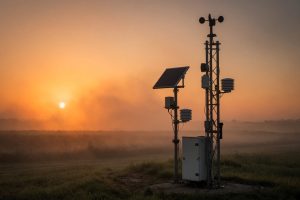
From the perspective of meteorological monitoring technology and applications, early warning is essentially a chain of “sensing–forecasting–dissemination–response.” On the sensing end, denser deployment of automatic weather stations, weather radars, atmospheric electric field instruments, and other surface and near-surface observation equipment can more promptly capture precursors of severe convective weather, torrential rain, lightning, and other hazardous weather. On the forecasting end, dense observational data need to be deeply integrated with numerical models and nowcasting algorithms to improve the spatial and temporal accuracy of warnings. On the dissemination and response end, multi-channel mechanisms such as emergency broadcasting, mobile text alerts, and community notifications should translate warnings into actionable information, truly bridging the “last mile.”
Multi-hazard early warning is not a purely technical issue; it is a systematic project comprising infrastructure, institutional development, and social response. The institutional coordination, financing guarantees, and universal coverage emphasized in the Action Call are precisely the key conditions for supporting the implementation and long-term operation of the technological system.
Source: World Meteorological Organization (WMO) (Link: https://wmo.int/media/news/addis-ababa-call-action-early-warnings-africa)
 WMO Report Warns: Wildfires and Heatwaves Weigh on Global Ai
 Essential Autumn Maintenance Checklist for Automatic Weather
 The Fundamental Workflow of Meteorological Data Quality Cont