
Meteorological data quality is the lifeblood of any monitoring system. In autumn, large day-night temperature differences, localized morning fog, and frequent strong winds are common, and sensors are easily affected by condensation and fallen leaves. Establishing a quality control workflow that covers acquisition, transmission, and processing is the basis for ensuring that industry users receive trustworthy data.
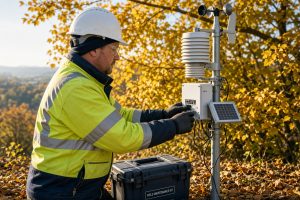
Step one is sensor-level quality control, centered on periodic verification and cleaning maintenance. Each sensor must be regularly compared against a traceable working standard. On autumn mornings, condensation often builds up on the probes of ultrasonic anemometers and causes signal attenuation, so the self-heating function should be checked. The surface of an atmospheric electric field mill must be kept dry and clean. Zero drift and abnormal responses are often the earliest quality risks to appear.
Step two is data acquisition and preprocessing. The data logger samples at a fixed frequency and generates minute-level or hourly values using moving averages and extreme-value screening. Aliasing should be avoided, and the sampling frequency needs to be at least twice the highest frequency of the signal. Because wind gustiness is stronger in autumn, transient mechanical spikes and physically impossible outliers should be removed before averaging. Preprocessing also includes consistency checks; for example, relative humidity records above 100% should be corrected, and pressure data must be reduced to sea level when used in elevation-dependent scenarios.
Step three is transmission and completeness monitoring. Wireless communication links can suffer packet loss and delays due to bandwidth and interference, so the data platform should check time-stamp continuity in real time. When the gap between adjacent records exceeds a set threshold, the system should automatically alarm and flag the missing interval. Rapid autumn temperature and humidity changes can disturb wireless signals; in such cases, signal-quality parameters can be added as completeness indicators. Missing data should not be treated as simple null values—the cause should be distinguished among device power loss, communication failure, and electromagnetic interference.
Step four is outlier detection and flagging. Common methods include physical threshold checks, adjacent-sample rate checks, and multi-station spatiotemporal consistency checks. For an atmospheric electric field mill, slow drift of the field under clear skies is normal, but the approach of thunderstorm clouds produces clear and sustained changes. If readings instantly exceed the instrument range or fluctuate frequently, the data should be marked as suspect. Local afternoon convection can still occur in autumn, so electric-field changes must be interpreted together with temperature, wind-field, and cloud-cover data to avoid misjudgments caused by any single variable.
The final step is manual review and closed-loop feedback. Automated quality control can only screen suspicious samples; industry experts need to make the final confirmation using onsite weather observations, equipment maintenance logs, and related records. For example, if a humidity sensor remains saturated during dense autumn fog, it is necessary to determine whether the reading reflects actual fog conditions or probe contamination. Once quality control findings are returned to the operations and maintenance team, they can support sensor calibration, cleaning schedule adjustments, and acquisition parameter optimization. Meteorological data quality control is a systematic process spanning hardware, acquisition, transmission, and software analysis—and it is a key capability to examine when assessing the reliability of meteorological monitoring equipment.
 WMO Report Warns: Wildfires and Heatwaves Weigh on Global Ai
 Africa Early Warning Action Call Highlights Gaps in Meteorol
 Essential Autumn Maintenance Checklist for Automatic Weather